1.Definition and Reactivity of Benzyne

Benzyne, also known as dehydrobenzene, refers to a structure formed by the removal of two hydrogen atoms from an unsaturated benzene ring, resulting in a formal carbon-carbon triple bond. Due to its highly strained formal triple bond structure, benzyne enables one-step ortho-difunctionalization of the benzene ring. As a highly reactive intermediate, it plays a significant role in medicinal chemistry, natural product chemistry, functional materials, and other fields.

2.Classical Synthesis and Limitations of Benzyne Precursors

The classical synthesis method for benzyne-type compounds was reported by Kobayashi in 1983. This method uses ortho-silylphenyl trifluoromethanesulfonate as a benzyne precursor, allowing controlled benzyne generation by modulating the solubility of fluoride salts. It features mild reaction conditions, broad substrate scope, and excellent functional group compatibility. However, the preparation of Kobayashi's benzyne precursors is relatively complex and limited to ortho-disubstitution of the benzene ring. Therefore, developing novel and easily synthesized benzyne precursors to achieve polyfunctionalization and non-ortho difunctionalization of benzene rings is of great importance.

3.Innovative Design and Application of Domino Benzyne Precursors

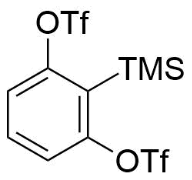
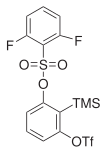
Professor Li Yang from Chongqing University innovatively applied the concept of "domino" to develop three novel domino benzyne precursors—TPBT, TTPM, and TTPF. These precursors enable the efficient and rapid construction of three or more substituted benzene rings, akin to knocking down domino tiles, with the following product features:

Structural Formula
Features

TPBT
  1. It can be activated by F⁻ or CO₃²⁻ under mild conditions to release domino benzyne intermediates, suitable for various reaction types with excellent functional group compatibility.
  2. It enables 1,2,3-functionalization of the benzene ring.

TTPM
  1. Building upon the first-generation TPBT, the leaving group trifluoromethanesulfonate (-OTf) at the C3-position of the benzyne was replaced with p-toluenesulfonate (-OTs). This modification significantly slows down the generation rate of the second benzyne, enabling efficient benzyne tandem reactions at 130 °C.
  2. The nucleophilic-ene and nucleophilic-[4+2] domino benzyne tandem reactions were successfully achieved.

TTPF
  1. Building upon the first-generation TPBT, the leaving group trifluoromethanesulfonate (-OTf) at the C3 position of benzyne was replaced with 2,6-difluorobenzenesulfonate. This modification results in reactivity intermediate between that of TPBT and the TTPM reagent, enabling efficient benzyne tandem reactions under relatively mild conditions at 80 °C.

J&K Scientific exclusively supplies a series of novel domino benzyne precursors—TPBT, TTPM, and TTPF—developed by the research group of Professor Li Yang at Chongqing University. 
These precursors overcome the limitation of ortho-disubstitution on benzene rings, enabling polyfunctionalization and non-ortho difunctionalization. They exhibit complementary reactivity and allow controllable benzyne generation rates.

Contact us for a quote

Related Products:

  • 2-(Trimethylsilyl)-1,3-phenylene bis(trifluoromethanesulfonate), 95% (CAS 1639418-72-6)
  • 3-(((Trifluoromethyl)sulfonyl)oxy)-2-(trimethylsilyl)phenyl 4-methylbenzenesulfonate, 95% (CAS 2181796-64-3)
  • 3-(((Trifluoromethyl)sulfonyl)oxy)-2-(trimethylsilyl)phenyl 2,6-difluorobenzenesulfonate, 95% (CAS 2393969-56-5)
By 李艳

Share:

Just added to your wishlist:
My Wishlist
You've just added this product to the cart:
Go to cart page