
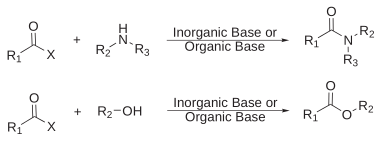
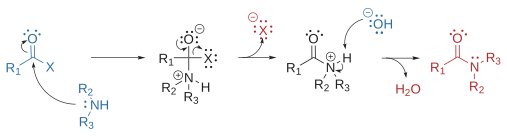
The synthesis of amides from amines and esters from alcohols with acyl halides or anhydrides in the presence of a base is known as the Schotten-Baumann reaction. The amine attacks the acyl halide, forming a tetrahedral intermediate that releases a halide ion. Deprotonation of the positively charged nitrogen affords the amide product. Esters are formed from alcohols in a similar fashion.
- Reagents: Original Conditions: Inorganic Base (NaOH, KOH, Na2CO3, NaHCO3), Water or Modified Conditions: Aprotic Solvent, Organic Base (Pyridine, DMAP, Et3N, etc.) and/or Lewis Acid (MgBr2, Sc(OTf)3, etc.)
- Reactant: Acyl Halide or Anhydride, 1° or 2° Amine, 1°, 2° or 3° Alcohol
- Product: Amide or Ester
- Type of Reaction: Nucleophilic Acyl Substitution
Mechanism
Top Citations
Related Compounds
- Base
- Lewis acid
- Acyl hailde
- Acid anhydride
- Alcohol
Need Bulk Quantities? Let’s Talk Strategy
To ensure you get the most competitive rates and reliable lead times for your specific scale, we offer customized pricing for industrial orders.
Contact our technical sales team today for a fast, formal quotation tailored to your project requirements.
