
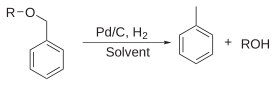
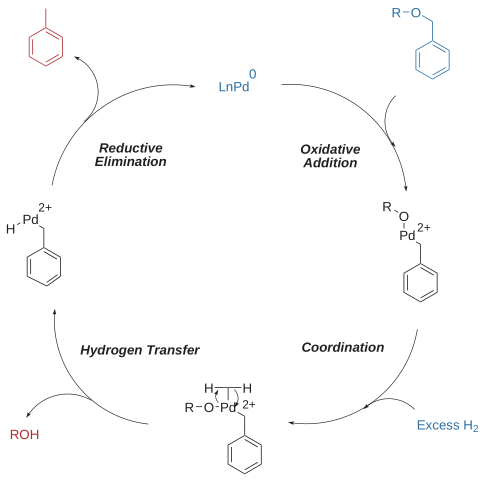
Benzyl groups are often used to protect alcohols in multi-step synthetic reactions. To deprotect, the benzyl ether first undergoes oxidative addition to the Pd(0) catalyst, forming a Pd(II) complex. Hydrogen coordination and transfer then facilitates the release of the alcohol. Reductive elimination expels toluene and regenerates the palladium catalyst.
- Reagents: Pd/C, H2, Solvent (EtOH, MeOH, THF, Toluene etc.)
- Reactant: Benzyl protected alcohol
- Product: Alcohol, Toluene
- Type of Reaction: Hydrogenolysis
Lab Tips
- Various other protocols have been developed, including using 1,4-cyclohexadiene as a hydrogen transfer source, [1] deprotection under mild, oxidative conditions, [2] or removal with chlorosulfonyl isocyanate-sodium hydroxide. [3][3][3][3]
1. Quinn et al. 1,4-Cyclohexadiene with Pd/C as a rapid, safe transfer hydrogenation system with microwave heating. Tetrahedron Lett. 2008, 49(42), 6137-6140.
2. Weinreb et al. Efficacious cleavage of the benzyl ether protecting group by electrochemical oxidation. J. Org. Chem. 1975, 40(9) 1356-1358.
Mechanism
Top Citations
- Debenzylation of N-Benzylamino Derivatives by Catalytic Transfer Hydrtyation With Ammonium Formate. Synthetic Communications 1987, 17 (4), 415–418.
- Influence of Catalyst Type, Solvent, Acid and Base on the Selectivity and Rate in the of 4-Chloro-N,N-Dibenzyl Aniline with PdC and H2. Journal of Molecular Catalysis A: Chemical 1996, 112 (3), 437–445.
Related Reactions
- N-Boc Protection and Deprotection
- Benzyl Protection of Alcohols
- Methyl-Ester Protection and Deprotection
Related Products
- TMS-Cl (CAS 75-77-4)
- DCM (CAS 75-09-2)
- Benzel Compound
Need Bulk Quantities? Let’s Talk Strategy
To ensure you get the most competitive rates and reliable lead times for your specific scale, we offer customized pricing for industrial orders.
Contact our technical sales team today for a fast, formal quotation tailored to your project requirements.
 Olica Xu
